

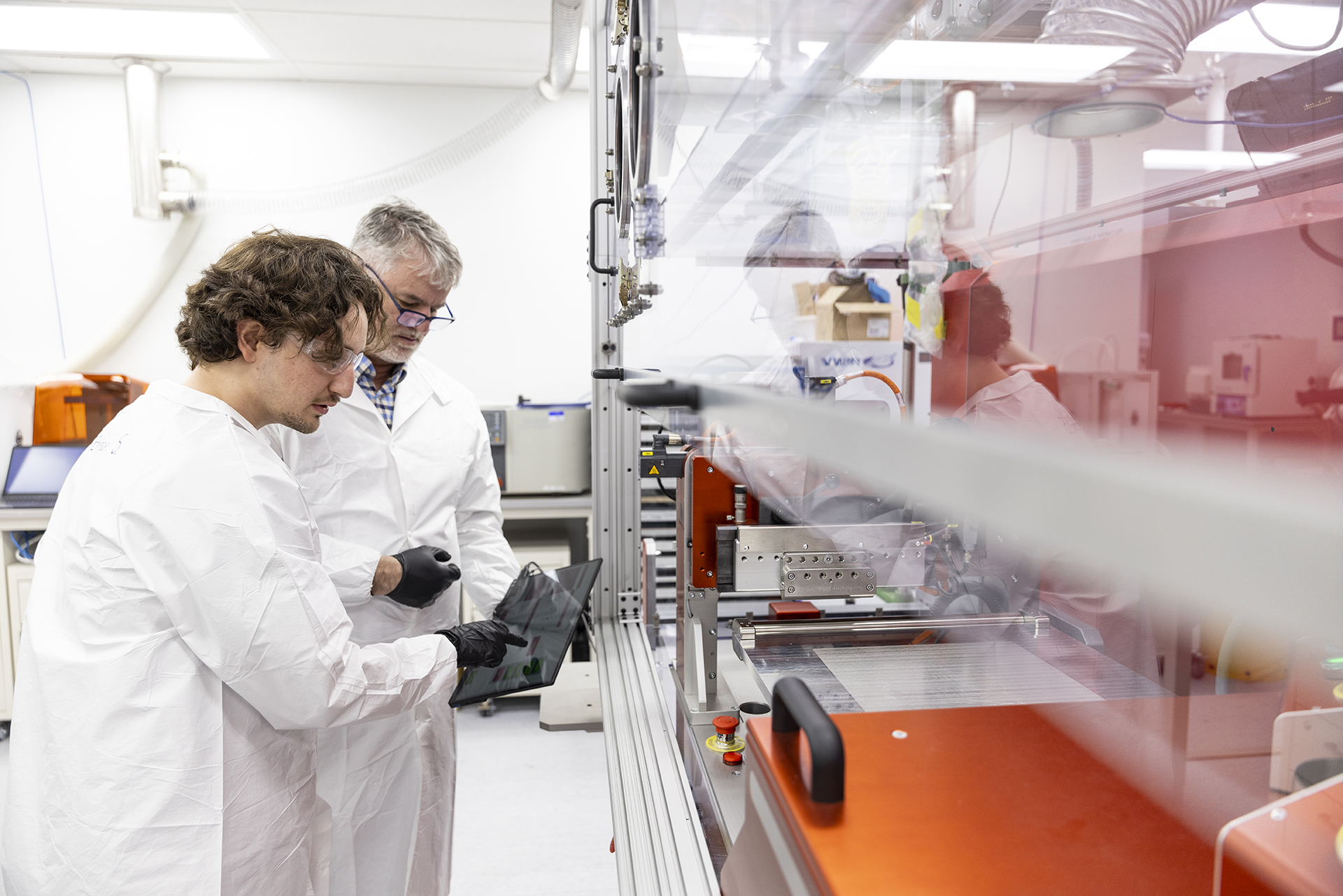
University of Washington mechanical engineering researchers are using next-generation methods to improve manufacturing processes for renewable energy technologies
April 21, 2025 | By Lyra Fontaine
At the University of Washington (UW) Clean Energy Institute’s (CEI) Washington Clean Energy Testbeds, researchers in the Department of Mechanical Engineering (ME) are using new 3D printing methods to develop energy devices, including solar cells, batteries and quantum materials. These processes reduce carbon footprints while improving scalability and efficiency.
That’s why ME Ph.D. candidate Ethan Schwartz is working on increasing solar cell manufacturing in Associate Professor Devin MacKenzie’s lab. He works with perovskites, a semiconductor material with properties that can be tuned for high performance and easy-to-scale manufacturing.
“Producing more solar cells by reducing the capital cost of manufacturing would be a big step toward more widespread clean energy adoption.”
— J. Devin MacKenzie
Schwartz identifies perovskite materials ingredients and process “recipes” to improve efficiency and prevent defects. Real-time sensors and a machine learning (ML) algorithm monitor and optimize the manufacturing process.
“The perovskite solar field evolves rapidly, with a new ‘recipe’ every few months,” MacKenzie says. “It’s important to adapt to new materials and methods that can be used to manufacture the large amount of solar panels required to meet our energy needs.”
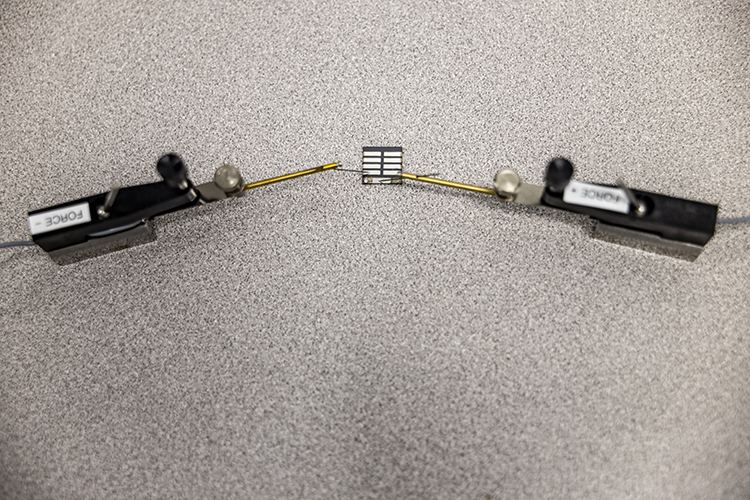
ML and sensors help researchers refine solar cells by predicting performance, correcting flaws and reducing waste.
“An optimal solar cell could depend on various factors — chemical composition, deposition speed, temperature, humidity and more,” says Schwartz, a CEI Graduate Fellow. “We don’t have time to test each variable individually. ML accelerates discovery, helping us better predict a solar cell’s performance and lifespan.”
The researchers hope to improve solar panels’ efficiency — which is currently around 25 percent — at converting light into electrical power.
Adapted from an article originally published by UW Mechanical Engineering.